
Plain Risk is an approach to understanding, describing, and managing risk.
Risk
A risk is a possibility of harm or loss. A risk description makes clear what could happen, who or what could be affected, and in which circumstances.
Plain Risk helps people explain what is at stake, what they know, what remains uncertain, and what they are prepared to accept.
Purpose
Plain Risk aims to help people understand risks and examine the grounds for assessing and responding to them. It supports descriptions and statements that others can understand, question, and use.
How a situation is described affects what people notice and consider significant. The approach connects an account of what could happen with consideration of why it matters and what might be done.
Objectives
The objectives of Plain Risk are to enable users to:
- Describe risks clearly, including what could happen and who or what could be affected.
- Explain who or what is exposed, how serious the possible harm could be, and how likely it is.
- Identify what is known, what is assumed, and what remains uncertain.
- Explain what measures are intended to achieve and examine how they work.
- Articulate what risks an organisation is prepared to accept, who may decide, and which conditions apply.
Concepts and description
The same situation can be described in different ways. The concepts we use shape what we are saying about it, with implications for which risks we identify, how we assess them, and how we respond.
Risk frameworks ask users to describe actions and situations under headings or categories, such as causes, events, consequences, and controls. Applying a framework therefore requires judgement about both the description and the category under which it belongs. How an action or situation is described affects where it fits and what conclusions can be drawn. Plain Risk makes these concepts and relationships explicit so that users can examine the descriptions on which their assessments depend.
See an example
A restaurant sends an unwell chef home. The same action can appear in two risk-register entries:
- “Food contamination could make customers ill”: sending the chef home is a control.
- “Staff shortages could delay service”: sending the chef home contributes to the shortage.
The action is the same, but its place in the register changes with the risk being described. Seeing both helps the manager protect customers and arrange cover. Calling the action a “control” alone could hide the other problem it creates.
Method
We start with simple, clear concepts. Concepts help us identify what is involved in a given situation. We use concise, structured definitions and sentence patterns to explain their meaning and connections, building basic models. The models associated with them represent how things are done or happen, identifying relevant elements and relationships. Sentence patterns are only one way to express these models and make their elements explicit. We also use visual diagrams to clarify the models involved.
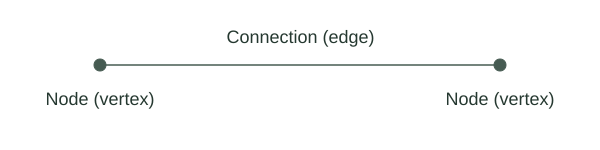
We use simple diagrams with nodes and labelled connections. Nodes represent the elements of a model, and connections show how they relate. Arrows indicate direction where the relationship requires it. These diagrams complement sentence patterns by showing several relationships together, helping users describe a situation, examine its structure, and explore possible changes.
This approach draws on Austin’s work on ordinary language and on Fillmore’s account of semantic frames.
A simple pattern makes a relationship explicit: an event could cause a loss; someone takes a precaution for a particular purpose; someone authorises an activity subject to conditions.
These models can be combined to examine a situation. A possible loss can be considered alongside what could cause it, what a precaution is intended to achieve, and what would justify proceeding. Cases help test the account and show what changes when the circumstances change.
The principal applications are risk descriptions and risk appetite statements. The same method can be used to examine controls, acceptance decisions, and the responsibilities attached to them.
Importance
Risk descriptions and appetite statements influence decisions about what to undertake, what to protect, and what precautions to take. Their wording can affect how people understand their authority and responsibilities.
Shared understanding matters to risk governance and risk culture. People need to understand what risks have been identified, what is acceptable, what has been authorised, and what is expected of them. Knowing the same facts can still leave differences in how their significance is understood.
Benefits
The intended benefits are a shared understanding of risks, clearer statements of appetite, clearer grounds for decisions, and a sounder basis for examining how risks are managed.
In practice, this can help people locate a disagreement, identify missing information, clarify the conditions of an approval, or distinguish a control’s intended purpose from its demonstrated effect.
The plain framework provides a simple baseline for understanding and critically examining other, more complex frameworks. It helps users recognise familiar concepts and relationships, identify differences, and assess what the other framework adds and whether its distinctions and connections make sense.
The framework is designed to develop analytical skills that support critical judgement. Through concepts, relationships and cases, users practise making distinctions, describing situations clearly, examining connections and giving reasons for their conclusions.
Apply this guidance to your own risk or an example.
Plain Risk, developed by Dr Julien Maréchal. © 2026 The Governance Practice.
Original materials: CC BY 4.0. Source. Scope and attribution.
Logos, third-party material, and website software are excluded.